Today, Samsung Electronics, announced that it has developed the world's first four gigabit (Gb) DDR3 DRAM chip, using 50 nanometer (nm) process technology.
With more and more data centers seeking a reduction in the number of servers they use, the development of low-power 4Gb DDR3 has become critical in reducing data center costs, improving server time management and increasing overall efficiency.
Using just 50 nanometer process technology, the 4Gb DDR3 DRAM chip runs at 1.6Gbps and is highly efficient consuming 40% less power, gulping only 1.35 volts to operate, in contrast to 1.5 volts consumed by the other DRAM chips. The 4Gb can be used in servers, desktop PCs, workstations and notebooks, given that it can be produced in chips in 16GB RDIMM, 8GB UDIMM and SODIMM modules.
DDR3 is 8 times faster than DDR2 memory and uses 30% less power. The new 50nm 4GB chip comes 5 months after Samsung introduced the first 2GB chips built using the 50nm process.
According to the International Data Corporation (IDC), a market research and analysis firm, the worldwide DDR3 DRAM market will account for 29 percent of the total DRAM market in 2009 and 75 percent in 2011. In addition, IDC estimates that 2Gb-or-higher DDR3 DRAM will make up three percent of the total DRAM market in 2009 and 33 percent in 2011 (units in bits).
If Samsung goes on to use its dual-die package technology, then its hoping for a breakthrough that will allow for 32GB DDR3 memory modules, giving a double boost to the chip capacity presently.
With more and more data centers seeking a reduction in the number of servers they use, the development of low-power 4Gb DDR3 has become critical in reducing data center costs, improving server time management and increasing overall efficiency.
Using just 50 nanometer process technology, the 4Gb DDR3 DRAM chip runs at 1.6Gbps and is highly efficient consuming 40% less power, gulping only 1.35 volts to operate, in contrast to 1.5 volts consumed by the other DRAM chips. The 4Gb can be used in servers, desktop PCs, workstations and notebooks, given that it can be produced in chips in 16GB RDIMM, 8GB UDIMM and SODIMM modules.
DDR3 is 8 times faster than DDR2 memory and uses 30% less power. The new 50nm 4GB chip comes 5 months after Samsung introduced the first 2GB chips built using the 50nm process.
According to the International Data Corporation (IDC), a market research and analysis firm, the worldwide DDR3 DRAM market will account for 29 percent of the total DRAM market in 2009 and 75 percent in 2011. In addition, IDC estimates that 2Gb-or-higher DDR3 DRAM will make up three percent of the total DRAM market in 2009 and 33 percent in 2011 (units in bits).
If Samsung goes on to use its dual-die package technology, then its hoping for a breakthrough that will allow for 32GB DDR3 memory modules, giving a double boost to the chip capacity presently.
Read more...
 First one is by using a service called
  The second option is by using
  The third and the final option is by using



 Once you enable offline Gmail, Google Gears downloads a cache of your mail; then, when ever you have a limited or no connectivity, Gmail can switch to offline mode. You can send and receive messages (which will be saved in your outbox and then will be sent when Gmail detects a connection) and also use other Gmail features as if you're online.


 "Whether you misspelled "pwned," back in the day when you were just a newbie to the internet, or you simply said something you wish you could take back -- now you can remove your commentary at any time," YouTube said in a blog post.
 This book contains all the information you need to get started with editing pages on Wikipedia. It gives you practical advice on creating articles and collaborating with fellow editors, improving existing articles, and working with the Wikipedia community to review new articles, mediate disputes, and maintain the site.

 He killed his 26-year-old wife at her parents home in Brown Lees, Staffordshire, on 12 May, 2008, Stafford Crown Court heard. Richardson tried to kill himself after the attack and was sentenced to life with a minimum of 17 years in prison. The couple had been living apart since the previous month, said Fiona Cortese, a spokeswoman for the Crown Prosecution Service, which is responsible for prosecuting cases in England and Wales.
 Wikipedia is apparently considering instituting a new editorial process that would require all updates to be approved by a "reliable" user. The so-called Flagged Revisions process would allow registered, trusted editors to publish changes to the site immediately. All other edits would be sent to a queue and would not be published until they get approved by one of Wikipedia's trusted team of editors.


 The speculation also states that the iPhone hardware will also be upgraded to use the quad-core processor for Serious gaming. As such, it would be a serious threat to not just other phones, but also to dedicated gaming platforms like the Sony PSP and Nintendo DS.
 Despite problems with upper management this past summer, Samsung, the South Korean consumer electronics giant, has released a protype of the LUXIA LED TV, the slimmest LCD television the world has ever seen.
 Everytime when a search is done in Google it evolves, seven grams of CO2 whereas an electric kettle generates about 15 gm. So when two Google searches are done at the same time then it generates almost the same amount of harmful CO2. But sources says that Google is “secretive” about its energy consumption and carbon footprint, and refuses to divulge the locations of its data centers. The Google system, which sends search queries to several competing servers that may be thousands of miles apart, “minimizes delays but raises energy consumption”.
 “I’m thrilled to announce the availability of the Windows 7 beta, which is on track to deliver simplicity and reliability,” Ballmer said. “Windows 7 and Windows Live are part of an incredible pipeline of consumer technology that is making it easier than ever for people to communicate, share and get more done.”
 The Kodak Zx1 is a weather-resistant video camera which gives high definition recording at 720p at 60 fps. The camera also supports SD/SDHC memory card slot (up to 32GB), HDMI output, a 2 inch LCD display and remote control compatible for a price of $150.
  RCom’s new scheme dubbed as Customer Experience Programme offers Rs 900 talk time on local calls and SMS which can be accrued by subscribers in daily packages of Rs 10 each for 90 days. Additionally the scheme also offers unlimited calls between 11.00 pm to 6.00 am within RCom network in Mumbai, Maharashtra and Goa. The scheme is also on offer along with various top-up cards.
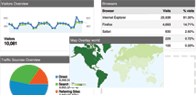
 The latest figures released by Net Applications, a company that tracks the browser usage, have shown that in December 2008, Internet Explorer was used by only 68.15% of Internet users, while Firefox has managed to maintain its market share over 20 percent, being used by 21.34% of users. And Apple's Safari pressed on to 7.93 percent, whereas Google's Chrome browser moved to 1.04 percent share, marking the first time the browser has hit the 1 percent milestone.